
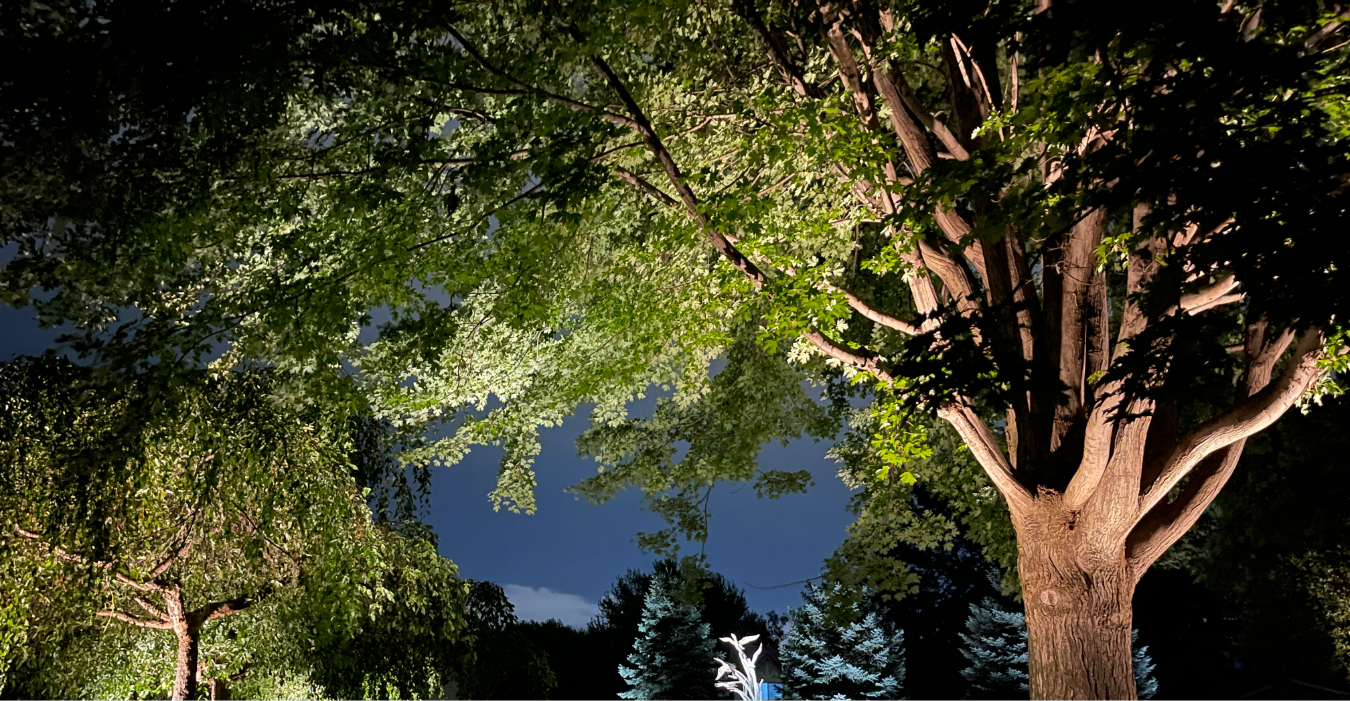
Tree lighting done well is one of the most transformative things you can do for a property after dark. A mature oak, ornamental cherry, or river birch becomes a completely different visual element at night when lit with the right technique – revealing bark texture, branch structure, and canopy depth that daylight flattens into the background. Done poorly, the same tree ends up washed out by a harsh uplight that creates glare rather than glow. This guide covers the techniques, fixture choices, and design principles that separate compelling tree lighting from the kind that looks like a spotlight aimed at a wall.
Quick Answer:The most effective tree lighting uses angled uplighting, moonlighting from the canopy, or layered combinations of both – always at 2700K to 3000K color temperature and lower wattage than most homeowners initially expect. Position matters more than brightness. A single well-placed 4W LED uplight at the right angle outperforms a 20W fixture aimed straight at the trunk.
Uplighting: The Foundation of Most Tree Lighting Designs
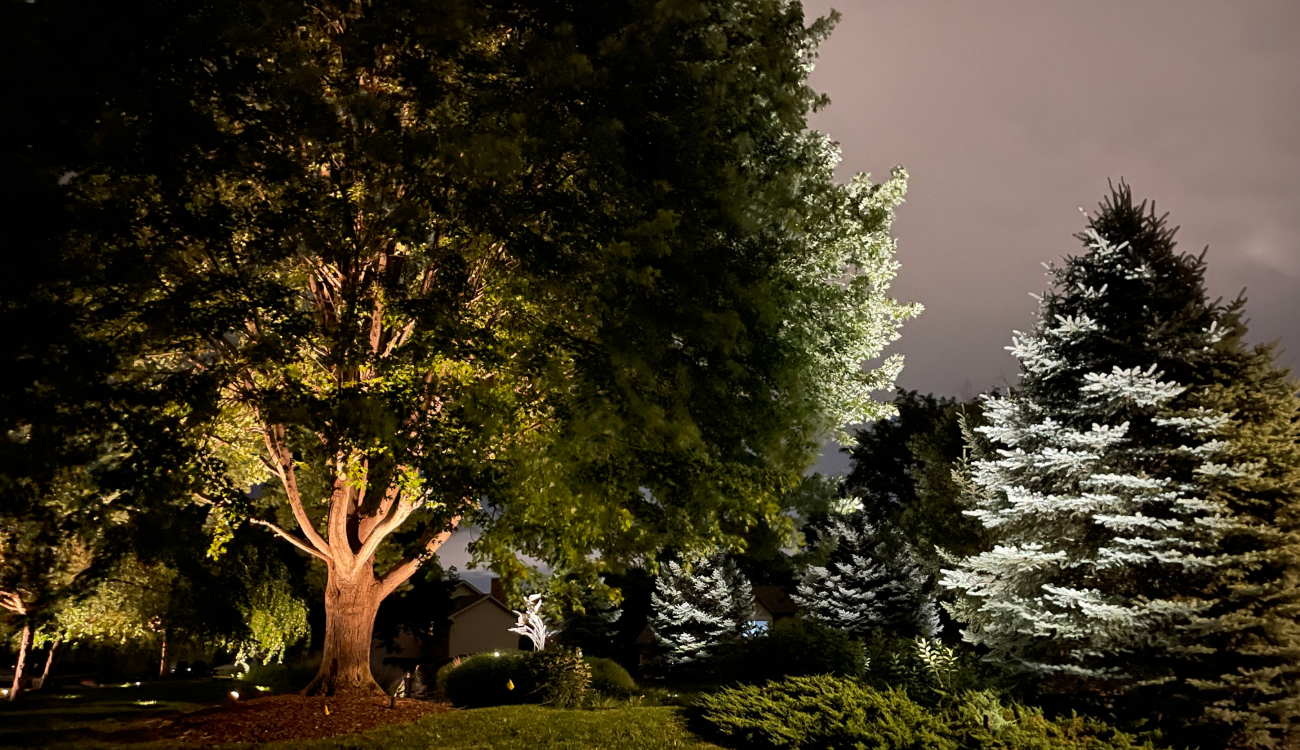
Tree lighting through uplighting places a fixture at or near ground level and directs the beam upward through the canopy. When executed correctly, this technique reveals bark texture, defines branch architecture, and fills the canopy with layered depth that changes beautifully with the seasons as leaf coverage grows and recedes. In Nebraska, the winter branch structure of a deciduous tree lit from below can be just as compelling as its full-canopy summer look.
The most common mistake is placing the fixture too close to the trunk and using too much wattage. A beam aimed straight up from the base produces a washed-out trunk with little texture and significant light waste above the canopy. The correct approach positions the fixture further from the tree – 18 to 36 inches depending on trunk diameter – angled inward so the beam travels across the bark surface rather than straight through it. This grazing angle reveals texture, creates natural shadow, and delivers far more visual interest at lower output.
Fixture Placement by Tree Size
- Small ornamentals (trunk under 10 inches): One fixture 18-24 inches from base, angled at 30-45 degrees. Output: 3W to 6W LED.
- Medium trees (10-20 inch trunk): Two fixtures at opposing angles 24-36 inches out. Eliminates the flat, single-source look.
- Large shade trees: Three or more fixtures at different perimeter positions. Multi-angle placement creates gradients of light and shadow that shift as you move around the tree.
Moonlighting: Tree Lighting That Works from Above
Moonlighting is the most elegant tree lighting technique available, and it produces an effect that ground-level uplighting simply cannot replicate. Rather than placing fixtures at ground level, moonlighting mounts fixtures 15 to 25 feet up inside the canopy and directs light downward through the branches. The result closely mimics natural moonlight filtering through leaves – soft, dappled shadows cast across the ground below, shifting gently with the breeze.
The ground beneath the tree becomes as visually interesting as the tree itself, covered in shifting light patterns that no other technique produces. Moonlighting works best for large shade trees with open canopies – mature oaks, elms, and maples common throughout Douglas and Sarpy counties are ideal candidates. It is also the most neighbor-friendly tree lighting approach, since the light source is hidden within the canopy and output is directed downward rather than outward, minimizing spillover onto adjacent properties.
Silhouetting and Shadow Projection
Silhouetting places a light source behind the tree, directed at a wall, fence, or solid background. The tree remains mostly unlit while its outline and branch structure appear in sharp profile against the illuminated surface behind it. This technique works best for trees with distinctive branch patterns – Japanese maples, river birches, and heavily pruned ornamentals where structural lines are strong and graphic.
Shadow projection extends this idea by using a focused beam to project branch patterns onto a wall or ground surface as an enlarged shadow. With the right fixture angle and a wall at the correct distance, a single small ornamental tree can fill an entire exterior wall with an ever-shifting pattern. This is particularly effective in narrow side yards or enclosed garden spaces where a larger fixture would feel out of scale. As a tree lighting technique, it delivers maximum visual drama with minimal fixture count.
| Technique | Visual Effect | Best For | Fixtures Needed | Avg. Cost Added |
|---|---|---|---|---|
| Uplighting (single) | Bark texture, canopy glow | Small ornamentals | 1 | $150 – $300 |
| Uplighting (multi) | 3D depth, shadow gradients | Large shade trees | 2-4 | $300 – $800 |
| Moonlighting | Dappled ground shadow | Mature oaks, elms | 1-2 (in canopy) | $400 – $900 |
| Silhouetting | Graphic outline profile | Japanese maple, birch | 1 | $150 – $350 |
| Shadow projection | Enlarged pattern on wall | Ornamentals near walls | 1 | $150 – $300 |
| Layered combination | Full dimensional result | Feature trees, any size | 3-6 | $600 – $1,800 |
Not sure which technique fits your trees?Our team evaluates each tree individually before recommending a tree lighting approach. We’ve designed systems for properties across Omaha, Douglas County, and Sarpy County since 2011 – and no two trees are lit exactly the same way. Schedule a free on-site consultation here.
Color Temperature and Why It Matters More Than Brightness
Color temperature is the variable most homeowners underestimate in tree lighting design. Measured in Kelvins, it describes the warmth or coolness of the light source. A 2700K LED produces a warm amber tone that makes bark look rich, foliage look lush, and stone and wood look natural. A 4000K or 5000K LED produces a cooler, bluer output that makes the same materials look flat and clinical.
For tree lighting specifically, 2700K to 3000K is the range that consistently produces compelling results on organic materials. Brightness, by contrast, should be minimized rather than maximized. According to the U.S. Department of Energy, quality LED fixtures deliver equivalent or superior output to halogen at 75% less energy – which means lower-wattage LEDs at the right placement deliver better results than higher-wattage fixtures aimed incorrectly. Less output at the right angle and right color temperature consistently outperforms more output at the wrong one.
Browse our project gallery to see how color temperature choices play out across completed tree and landscape lighting installs in the Omaha metro.
Layering Light for Depth and Dimension
The most compelling tree lighting installations layer multiple techniques rather than relying on one. A large oak might receive uplighting from two ground fixtures, a moonlighting fixture mounted in the canopy, and a path light nearby that spills across the root zone and lower trunk. Each element contributes something distinct – texture, shadow, ambient glow – and together they create a scene that rewards viewing from multiple distances and angles.
The principle that makes layering work is restraint. Every fixture added to a composition should serve a clear purpose: revealing texture, defining an edge, casting shadow, or establishing a focal point. Fixtures added without a specific purpose produce visual noise rather than visual depth. The best tree lighting designs always leave some areas intentionally unlit, because contrast is what makes the lit areas feel compelling. Our residential lighting service is built around this layered design approach for every property we work on.
Ready to transform your trees after dark?Midwest Lightscaping has designed tree lighting systems for 1,000+ properties across the Omaha metro since 2011. Every project starts with a free on-site evaluation of your specific trees – no catalog approach, no generic solutions. Request your free consultation here.
Frequently Asked Questions
Can tree lighting damage roots or bark?
When installed correctly, professional landscape lighting does not damage tree roots or bark. Low-voltage fixtures are positioned to avoid major root zones, and modern LED fixtures produce very little heat, eliminating the risk of bark damage from fixtures near trunks. Properly routed conduit and careful installation protect both the electrical system and the tree’s health over time.
What types of trees look best with outdoor lighting?
Trees with interesting bark texture, strong branch architecture, or distinctive silhouettes respond best. Oaks, maples, birches, ornamental cherries, Japanese maples, and magnolias are excellent candidates. Even trees with less dramatic individual features become compelling when lit from the right angle, particularly for shadow projection or canopy glow effects.
How many fixtures does a single tree need?
A small ornamental may look its best with one well-placed uplight. A large shade tree with a wide canopy typically benefits from two to four fixtures positioned at different angles to eliminate flat spots and create a three-dimensional effect. A professional site evaluation is the most reliable way to determine the right number for a specific tree.
What is the best color temperature for tree lighting?
2700K to 3000K warm white is the standard recommendation for tree and landscape lighting. This range brings out amber and red undertones in bark, makes foliage look rich rather than pale, and creates an inviting overall atmosphere. Cooler temperatures above 4000K tend to make organic materials look flat and clinical.
Does tree lighting work year-round in Nebraska?
Yes. Quality outdoor fixtures rated for exterior use perform reliably through Nebraska’s temperature extremes. The effect itself changes with the seasons: summer canopy glow, fall foliage illumination, winter branch structure definition, and spring bloom highlighting each offer distinct and compelling nighttime views of the same tree.
Conclusion: Tree Lighting That Works With Your Landscape, Not Against It
The best tree lighting doesn’t announce itself. It reveals what was already there – the texture in the bark, the architecture of the branches, the natural canopy structure that daylight makes easy to overlook. Whether the right approach for your property is uplighting, moonlighting, silhouetting, or a layered combination, the design should start with the tree itself rather than with a fixture catalog.
Midwest Lightscaping has designed and installed tree lighting systems across Omaha, Douglas County, Sarpy County, and the surrounding region since 2011. Our team has completed 1,000+ outdoor lighting projects and earned the Best of Omaha award every year since 2015, including first-place finishes from 2021 through 2025. We offer ongoing maintenance programs to keep every system performing at its best long after installation.
If you’re in Omaha, Midwest Lightscaping is ready to help – midwestlightscaping.com/contact-us/