
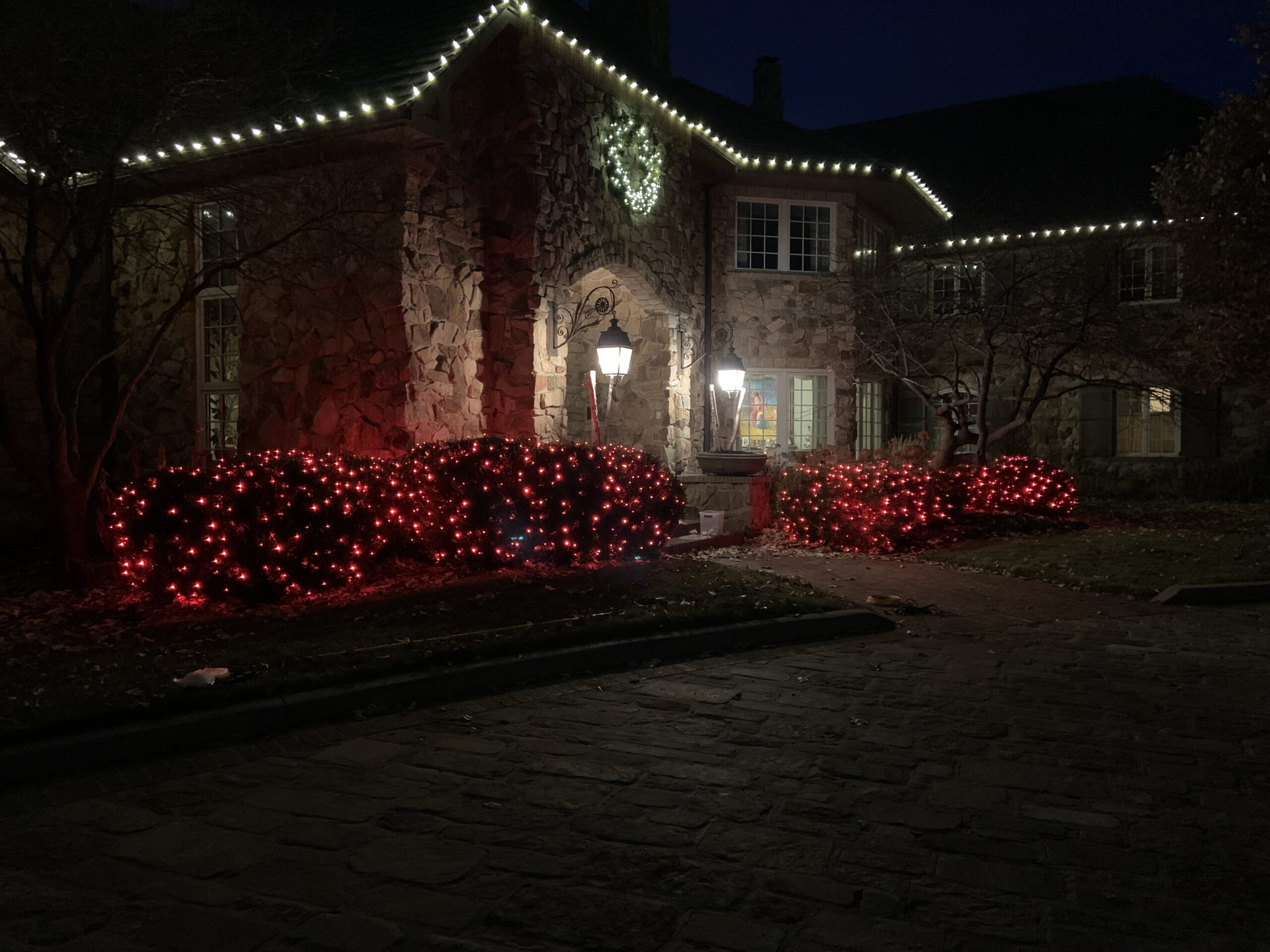
LED lighting is the appropriate specification for nearly every outdoor holiday application. This comparison evaluates LED and incandescent Christmas lights across thirteen factors, including cost, efficiency, durability, and visual quality, so that property owners can select lighting based on performance and design intent rather than packaging claims.
Midwest Lightscaping designs, installs, and maintains custom outdoor lighting for residential and commercial properties in the Omaha area. The assessments below reflect the performance standards applied to every project: light that looks intentional, operates reliably, and remains consistent from season to season.
| Factor | LED | Incandescent |
| Purchase cost | Higher | Lower |
| Energy use | 75% to 90% less power | Most energy released as heat |
| Seasonal operating cost (300 ft C9 roofline) | About $9 | About $66 |
| Rated lifespan | 25,000 hours or more | About 1,000 to 3,000 hours |
| Durability | Impact-resistant epoxy or polycarbonate | Breakable glass |
| Color temperature | Varies by product; quality warm white near 2,700K | Consistently warm, about 2,200 to 2,700K |
| Flicker | None on full-wave sets; visible on half-wave sets | None |
| Light distribution | Concentrated point of light; diffused lenses soften it | Soft glow in all directions |
| Heat output | Cool to the touch | Large bulbs become hot |
| Snow performance | Snow can cover bulbs | Heat melts light snow |
| Sets per run | Many | Few |
| Maintenance | Minimal; sealed strings are replaced, not repaired | Ongoing bulb and fuse replacement |
| Availability | Expanding selection | Narrowing selection |
Factor-by-Factor Comparison
Purchase Cost
LED lights carry a higher purchase price than incandescent lights, and the gap widens as product quality increases. A basic incandescent string is inexpensive, which makes it appealing for a single season or a small display. The comparison changes once lighting is installed year after year, because one quality LED set can outlast several incandescent sets. Purchase cost is therefore best judged against the number of seasons a product will serve, not the price on the shelf.
Energy Efficiency
An incandescent bulb produces light by heating a filament, and most of the energy it draws is released as heat. An LED produces light from a semiconductor, so a far greater share of its power becomes visible light. In practical terms, LEDs typically draw 75% to 90% less power for comparable output. The gap is largest with large bulb sizes such as C7 and C9, which are the sizes most often used on rooflines.
Operating Cost
Operating cost depends on the size of the display. For a single tree, the difference between LED and incandescent is about a dollar per season. Across a full roofline, it becomes a meaningful annual saving.
Seasonal Operating Cost
Estimate the Energy Cost of Your Display
Based on 240 hours of use per season (six hours per night for forty nights). C9 estimates assume 12-inch bulb spacing at about 7 watts per incandescent bulb and 1 watt per LED bulb. Mini string estimates assume about 40 watts per incandescent string and 5 watts per LED string. Actual wattage varies by product.
Lifespan and Reliability
Quality LEDs are rated for 25,000 hours or more, compared with roughly 1,000 to 3,000 hours for incandescent bulbs. At 240 hours per season, the rated life of an LED exceeds any practical period of ownership. In service, the LED itself rarely fails. Wiring, plugs, connectors, and moisture seals determine real-world lifespan, which is why build quality outweighs the published rating. A well-constructed commercial-grade string can serve a property for many seasons, while an inexpensive one may fail within two or three.
Durability and Weather Resistance
LED bulbs are typically molded from epoxy or polycarbonate and resist impact, while incandescent bulbs are glass and break under ordinary handling, during installation, or in strong wind. For weather, the weak points are the connections rather than the bulbs. Molded one-piece strings and screw-tight connections keep moisture out, which prevents the most common cause of outdoor failure. Snap-in bulbs and thin insulation allow water to reach the electrical contacts, regardless of whether the set is LED or incandescent.
Light Quality and Color Temperature
Classic incandescent Christmas lights produce a warm glow of approximately 2,200 to 2,700 Kelvin. Early LEDs appeared harsh and bluish, which established the technology’s reputation for cold light. Quality warm white LEDs near 2,700K now match the traditional appearance closely. However, the term warm white is not standardized, and lower-cost products can appear stark, greenish, or noticeably different from one production run to the next. Specifying a defined color temperature and purchasing in a single batch is essential for a consistent result.
Flicker and Rectification
Lower-cost LED strings commonly operate on half-wave rectification, which produces a subtle flicker that registers in peripheral vision and on camera. Full-wave rectified strings deliver steady, continuous light. A practical check is to record the lights with a phone camera, where flicker appears as pulsing or banding in the footage. Flicker-free output is a defining characteristic of professional-grade LED lighting.
Brightness and Light Distribution
Incandescent bulbs radiate a soft glow in all directions, while many LEDs emit a concentrated point of light. Claims that one technology is simply brighter than the other are unreliable, because perceived brightness depends on the lens, bulb size, and spacing. Diffused or frosted lenses, appropriately sized bulbs, and consistent spacing allow LEDs to read as a continuous line of light rather than a row of individual points. These choices are a matter of design, and they affect the finished result more than the light source does.
Heat Output and Fire Safety
LEDs operate at low temperatures, which reduces risk near dry greenery, wood trim, and fabric. Large incandescent bulbs, by contrast, can become hot enough to scorch nearby materials over a long evening. LED lighting is not inherently safe, however: overloaded circuits, damaged cords, and products not rated for outdoor use remain hazards. A UL listing is the baseline requirement, with a red holographic label indicating suitability for indoor and outdoor use and a green label indicating indoor use only.
Cold-Weather and Snow Performance
LEDs perform reliably in freezing temperatures. Two conditions require attention in Nebraska winters. Cord insulation stiffens in the cold, so installation is best completed in milder conditions, avoiding sharp bends or forceful handling. In addition, incandescent bulbs emit enough heat to melt light snow, while LEDs do not, and accumulated snow or ice can cover cool bulbs and diminish their glow. Placement on surfaces where snow sheds naturally addresses this condition.
Installation, Circuit Capacity, and Controls
Because LEDs draw very little power, a considerably larger number of sets can be connected end to end than with incandescent lights, up to the maximum stated on the packaging. This reduces the number of cords, connections, and power sources required for a given design. Standard dimmers can cause LED flicker or buzzing and should be replaced with LED-compatible models, and timers should be rated for the connected load. Each connected run should contain one type of light to maintain consistent load and appearance.
Maintenance
Incandescent strings require pre-season testing, bulb replacement throughout the season, and attention to fuses and loose sockets. LED strings with sealed, molded construction remove most of these tasks. The trade-off is repairability: a sealed LED string generally cannot be opened or rebulbed, so a damaged section usually means replacing the string. Careful removal and storage in a dry, temperature-controlled location extend the service life of either type.
Availability and Long-Term Outlook
Incandescent holiday lights are not prohibited. The federal efficiency standards that phased out standard household bulbs generally do not apply to decorative holiday strings. Nevertheless, retail and commercial selection continues to narrow, and replacement bulbs for existing incandescent sets become harder to source each year. LED selection, by contrast, continues to expand in bulb styles, color temperatures, and control options.
When Incandescent Lighting Remains Appropriate
Three circumstances justify continued use of incandescent lights: existing strings that remain in good working order and can be replaced with LED as they fail; traditional designs requiring a specific vintage glow, provided alternatives have been compared side by side at night; and small, short-term, indoor applications in which energy use and heat do not matter.
How to Verify LED Holiday Lighting Before Purchase
- Color temperature: confirm the Kelvin rating is printed on the box. “Warm white” without a number is not a specification.
- Flicker: look for “full-wave” or “flicker-free” in the product details. If neither is stated, assume the set is half-wave.
- UL mark: check for the holographic UL mark on the cord near the plug, not only on the packaging.
- Wire gauge: check the gauge printed on the cord. A lower number means heavier wire, and commercial-grade sets typically use heavier wire than retail sets.
- Connection limit: read the maximum number of sets that can be connected end to end, and plan runs around it.
- Product and lot numbers: confirm that every box shares the same product code and, where printed, the same lot number. Order spares at the same time.
Design Considerations Beyond Bulb Selection
The most frequent shortcomings in holiday lighting are not caused by the choice of light source. They result from the absence of a plan: uniform lighting on every surface, mismatched color temperatures, exposed cords, and no focal point to direct the eye. Effective outdoor lighting is organized around how the property is seen.
- Hierarchy: define the primary feature, whether the roofline, the entry, or a specimen tree, and let every other element support it.
- Color consistency: apply a single color temperature across the property, matched to any existing landscape and architectural lighting.
- Concealment: conceal cords, connections, and timers.
- Sightlines: design for both the approach from the street and the view from within the home.
- Restraint: a smaller number of well-placed lights often looks better than a larger display spread evenly across the house.
Properties with an existing, well-designed landscape lighting system begin with a significant advantage, since architecture and plantings are already shaped by light before any seasonal layer is introduced.
Professional Recommendation
For outdoor holiday lighting, LED is the recommended choice, with products selected using the verification steps above. Incandescent lighting is appropriate only in the limited circumstances already described.
Midwest Lightscaping provides custom outdoor lighting design, installation, maintenance, and service, including seasonal holiday lighting, for homeowners, custom home builders, architects, landscape designers, developers, and commercial, senior living, and hospitality property managers. Our standing in the Omaha community, reflected in our BBB rating, Google reviews, and Best of Omaha recognition, rests on a single standard: a finished property that looks better at night than anyone imagined. To discuss a lighting plan for your property, schedule a design consultation.