
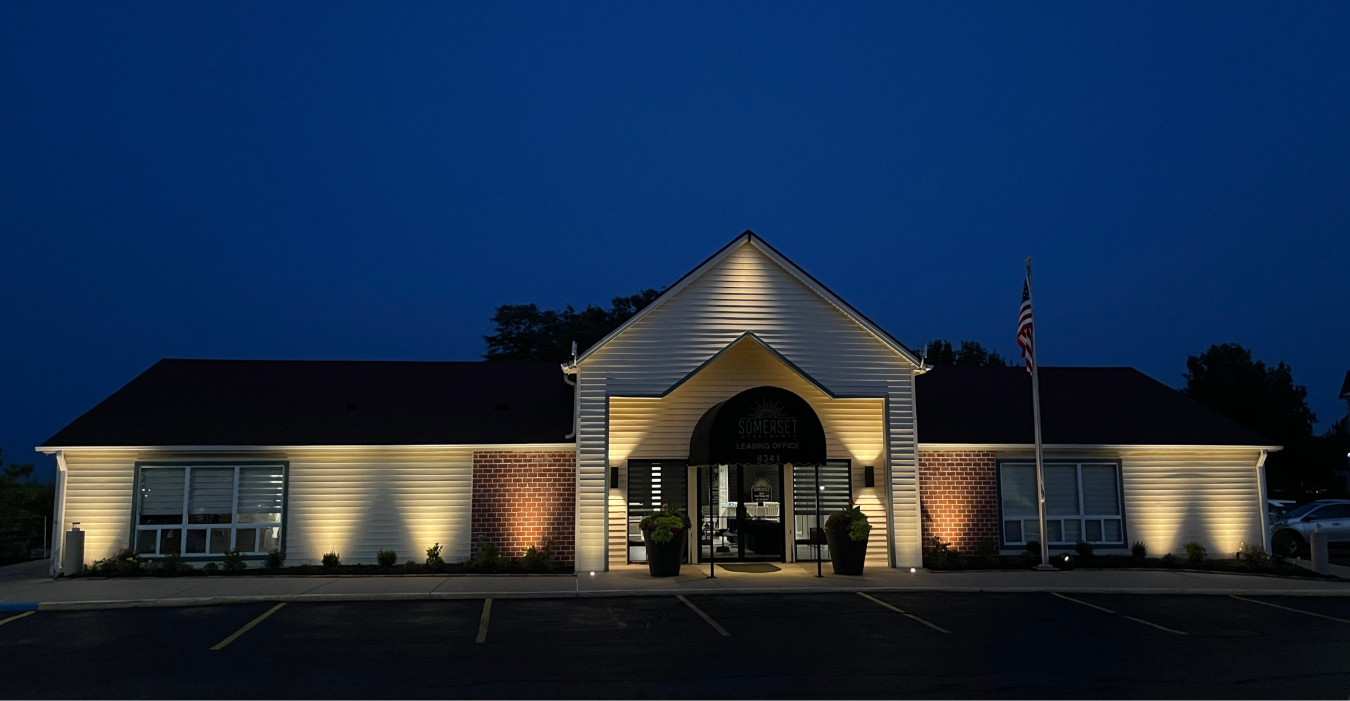
Commercial property lighting code requirements in Nebraska come from four rulebooks that each cover a different part of your project. The Nebraska Energy Code sets wattage limits and automatic controls, and the National Electrical Code (NEC) covers wiring. The Life Safety Code covers emergency lighting, while the Americans with Disabilities Act (ADA) limits where fixtures can stick out along walkways.
On top of those, your city’s zoning rules can limit glare and light spilling onto neighboring homes. Midwest Lightscaping has designed and installed outdoor lighting for businesses and homes in the Omaha and Lincoln areas since 2011. The company belongs to the Greater Omaha Chamber and the Association of Outdoor Lighting Professionals. Your local building and electrical inspectors make the final call, so confirm the details with them before you order fixtures.
Commercial Property Lighting Code Requirements at a Glance
Most commercial lighting projects in Nebraska come down to five rules:
- Exterior lights have to turn off automatically when daylight is available.
- Facade and landscape lighting has to shut off automatically after business hours, and parking lot lighting has to dim by at least 30 percent overnight.
- Total lighting wattage has to stay under the energy code’s limit for your building type and site.
- Emergency lighting has to come on within 10 seconds of a power failure and run for at least 90 minutes.
- Wall-mounted fixtures between 27 and 80 inches high along a walkway can’t stick out more than 4 inches.
Which Energy Code Nebraska Uses for Commercial Buildings
Nebraska’s commercial energy code is the 2018 International Energy Conservation Code (IECC), with ASHRAE Standard 90.1-2016 allowed as an alternate path. The Nebraska Department of Water, Energy, and Environment confirms the state moved to these codes under LB 405, and they took effect on July 1, 2020.
If your city or county hasn’t adopted its own energy code, that state department enforces the state code there. Nebraska is a home-rule state, so local jurisdictions can adopt energy codes stricter than the state minimum.
Designers usually prove compliance with COMcheck, free software from the U.S. Department of Energy that checks a building’s lighting and other systems against the 2018 IECC or ASHRAE 90.1.
When a Lighting Project Has to Meet the Energy Code
New buildings, additions, and most lighting alterations have to meet the energy code’s lighting rules. Under the 2018 IECC, an alteration only gets a pass when it replaces less than 10 percent of the fixtures in a space and doesn’t raise that space’s lighting wattage.
Swapping only the bulbs or drivers (the power component inside an LED fixture) in existing fixtures counts as a repair, as long as the wattage doesn’t go up. An addition has to meet the code on its own, and the unaltered parts of the existing building don’t have to be upgraded because of it.
Exterior Lighting Rules for Commercial Properties
The Nebraska Energy Code requires automatic controls on nearly all exterior lighting at a commercial property. The Lighting Controls Association’s summary of the 2018 IECC breaks those controls into daylight shutoff, after-hours shutoff for decorative lighting, and overnight dimming for everything else. The code also caps total exterior wattage.
Daylight Shutoff for All Exterior Lights
Every exterior light needs a control that turns it off automatically when daylight is available, which in practice means a photocell, a small sensor that reads outdoor light levels. Parking lot poles, wall packs, canopy lights, and landscape lighting all fall under this rule.
After-Hours Shutoff for Facade and Landscape Lighting
Lighting that washes a building’s facade or highlights its landscaping has to shut off automatically overnight, based on dusk and dawn plus a set closing and opening time. That covers uplights on trees, wall grazing on a storefront, and accent lighting on entry features.
Decorative lighting along a storefront roofline lights the facade too, so plan for permanent outdoor lighting on a commercial building to run on the same after-hours schedule.
Overnight Dimming for Parking Lot and Area Lighting
All other exterior lighting has to automatically cut its power by at least 30 percent overnight. The reduction can run from midnight to 6 a.m., from one hour after closing to one hour before opening, or any time no activity is detected for 15 minutes.
Motion sensors on parking lot poles are a common way to meet this rule, because the lights stay at full output when a car pulls in and dim once the lot empties.
Limits on Total Exterior Lighting Wattage
The energy code caps how many watts of exterior lighting a commercial property can install. The allowance depends on what you’re lighting, such as parking areas, walkways, entrances, and facades, and on the site’s lighting zone, a rating that runs from rural parkland up to busy commercial districts.
LED fixtures make the cap easier to meet, but a design that over-lights a parking lot can still exceed the allowance.
Exterior Lighting That Doesn’t Need Automatic Controls
Lighting required for health and life safety, including emergency lighting meant to stay on, is exempt from the exterior control rules. Areas that need continuous light for security or eye adaptation, such as covered parking entrances and exits, can also be exempt.
Interior Lighting Rules for Commercial Buildings
Inside a commercial building, the Nebraska Energy Code limits lighting wattage per square foot and requires controls that turn lights off or down when rooms are empty or lit by daylight.
Lighting Power Density Limits
Lighting power density (LPD) is the total lighting wattage divided by the floor area, measured in watts per square foot. Designers calculate it with the Building Area Method, which uses one limit for the whole building type, or the Space-by-Space Method, which sets a separate limit for each type of room.
Required Occupancy Sensors, Dimming, and Daylight Controls
Occupancy sensors have to turn lights off within 20 minutes after everyone leaves classrooms, offices, conference rooms, break rooms, restrooms, and storage rooms. Most spaces also need a manual control that can cut the lighting load by at least 50 percent in an even pattern.
Areas next to windows or under skylights need daylight-responsive controls that dim the lights automatically when the general lighting in that daylight zone totals more than 150 watts.
Lighting Rules for Apartment Units
In apartment buildings, at least 90 percent of the permanently installed lamps in each dwelling unit have to be high-efficacy lamps, meaning bulbs that meet minimum lumens-per-watt ratings. The minimum is 60 lumens per watt for lamps over 40 watts, 50 lumens per watt for lamps from 15 to 40 watts, and 40 lumens per watt for lamps under 15 watts.
Additional Efficiency Package Requirement
Buildings using the 2018 IECC prescriptive path also have to pick at least one extra efficiency option from Section C406 of the code. Two of the options involve lighting: cutting lighting power at least 10 percent below the code limit, or installing digital lighting controls with continuous dimming and individual fixture control.
Emergency and Exit Lighting Requirements
Commercial buildings in Nebraska need emergency lighting that turns on within 10 seconds of a power loss and runs for at least 90 minutes. That rule comes from the Life Safety Code (NFPA 101), which the Nebraska State Fire Marshal adopts as the core of the state fire code.
At the start of an outage, emergency lighting has to average at least 1 foot-candle along the exit path, with no spot below 0.1 foot-candle. A foot-candle measures how much light lands on a surface, and by the end of 90 minutes the average can drop to 0.6 foot-candle with no spot under 0.06.
Emergency Lighting Testing Schedule
Battery-powered emergency lights need a 30-second functional test every month and a 90-minute test once a year, with written records kept for the fire inspector. Self-testing units that run their own checks every 30 days are an allowed alternative to manual monthly tests, and they still need records.
Outdoor Lighting at Exit Doors
Egress lighting, meaning the light along a building’s exit path, doesn’t stop at the door. The Life Safety Code includes the exit discharge, the route from the exit door to a public way, and controls can’t leave that route dark while the building is occupied.
Plan the lights over exterior exit doors as part of the egress design rather than only as security lighting. The energy code’s after-hours shutoff doesn’t apply to lighting required for life safety, so those fixtures belong on a separate control from your decorative lighting.
ADA Rules for Light Fixtures Along Walkways
The ADA limits how far light fixtures can stick out into any walkway, inside or outside the building. Under the U.S. Access Board’s protruding object rules, a wall-mounted fixture with its bottom edge between 27 and 80 inches above the ground can project no more than 4 inches from the wall.
Fixtures on posts or poles with a leading edge in that same 27-to-80-inch zone can overhang the walkway by no more than 12 inches. Every walkway also needs at least 80 inches of clear headroom, so hanging fixtures and low canopy lights can’t dip below that height.
Fixtures mounted with their leading edge at 27 inches or lower, like most path lights and bollards, sit where a cane can detect them. The protrusion limit doesn’t apply to those fixtures, as long as they don’t narrow the accessible route.
Electrical Code and Licensing Rules for Commercial Lighting Work
Commercial lighting wiring in Nebraska has to be installed by a licensed electrician working for a licensed contractor. The state’s homeowner exception only covers a single-family home the owner lives in, so it never applies to a commercial property.
Nebraska enforces the 2023 National Electrical Code with state amendments, and Omaha adopted the full 2023 edition in December 2025. Omaha also requires every electrician working in the city to register with the city and file a copy of their state license.
Every outdoor fixture needs a wet-location or damp-location rating that matches where it’s mounted. Outdoor receptacles, including the ones that power seasonal or plug-in lighting, need GFCI protection, a safety device that cuts power when electricity leaks to the ground.
Local Zoning Rules for Glare and Light Trespass
Many cities add their own outdoor lighting rules through zoning or site plan review, separate from the building and energy codes. These rules often limit pole height, require shielded fixtures that aim light downward, and cap how much light spills onto neighboring homes, which planners call light trespass.
Ask your city’s planning department whether your project needs a photometric plan, a drawing that maps light levels across the site in foot-candles. An outdoor lighting design that starts with property lines and exit paths makes the zoning, energy code, and ADA limits easier to meet in one plan.
Commercial Lighting Code Checklist for Nebraska Property Owners
Work through these steps before you order fixtures or schedule an install:
- Call your building department and confirm which energy code and electrical code editions apply at your address.
- Ask the planning department whether the site needs a photometric plan or has lighting limits near residential lots.
- Have your designer run COMcheck to confirm interior and exterior lighting wattage stays under the code allowance.
- Put all exterior lights on daylight shutoff, facade and landscape lighting on an after-hours schedule, and parking lighting on a 30 percent overnight reduction.
- Keep egress lighting at exit doors on controls separate from your decorative lighting schedule.
- Hire a licensed electrical contractor and look up their license in the Nebraska State Electrical Division’s licensee search.
- Set up monthly and annual emergency lighting tests and keep the written records.
Lighting controls drift out of compliance over the years. Power outages can reset time clocks, and photocells and sensors get covered by snow or knocked out of aim, so outdoor lighting maintenance visits should include a check of every schedule and sensor.
Frequently Asked Questions About Commercial Lighting Codes in Nebraska
What energy code does Nebraska use for commercial buildings?
Nebraska uses the 2018 International Energy Conservation Code for commercial buildings, with ASHRAE Standard 90.1-2016 allowed as an alternative. The code took effect statewide on July 1, 2020. Cities and counties can adopt stricter energy codes, so confirm the edition with your local building department.
Do exterior lights on a commercial building need a photocell or timer?
Yes, nearly all exterior lighting on a commercial building needs a photocell or similar control that shuts it off in daylight. Facade and landscape lighting also needs an after-hours shutoff, and parking lot lighting has to dim by at least 30 percent overnight or after 15 minutes with no activity.
How long does commercial emergency lighting have to last in Nebraska?
Emergency lighting in Nebraska commercial buildings has to run for at least 90 minutes on backup power and come on within 10 seconds of an outage. Battery-powered units need a 30-second test every month and a 90-minute test every year, with written records.
Does replacing light fixtures trigger the energy code?
Replacing 10 percent or more of the fixtures in a space means the new lighting has to meet the 2018 IECC lighting rules, including the control requirements. Swapping only bulbs or drivers inside existing fixtures counts as a repair, as long as the total wattage doesn’t increase.
Can a business owner install commercial lighting without a licensed electrician?
No, Nebraska’s homeowner exception only applies to a single-family home the owner lives in. Wiring for commercial lighting has to be done by a licensed electrician working for a licensed contractor, and Omaha also requires electricians to register with the city.
Does the ADA regulate outdoor light fixtures?
Yes, the ADA’s protruding object rules apply to exterior walkways as well as interior halls. Wall fixtures between 27 and 80 inches high can stick out no more than 4 inches, post-mounted fixtures in that zone no more than 12 inches, and every walkway needs 80 inches of headroom.
Getting Commercial Lighting Designed to Nebraska Code
Commercial property lighting in Nebraska has to meet the 2018 IECC energy rules, the 2023 National Electrical Code, the Life Safety Code for emergency lighting, and ADA placement limits, plus any local zoning. For exterior projects, the rules that shape the design most are automatic shutoff and dimming controls, total wattage limits, and egress lighting at exit doors.
Start by calling your building department to confirm which code editions apply at your address. When you’re ready to plan parking, facade, or landscape lighting for a business in the Omaha or Lincoln area, talk with Midwest Lightscaping about commercial lighting at (402) 509-2810 or info@midwestlightscaping.com.