
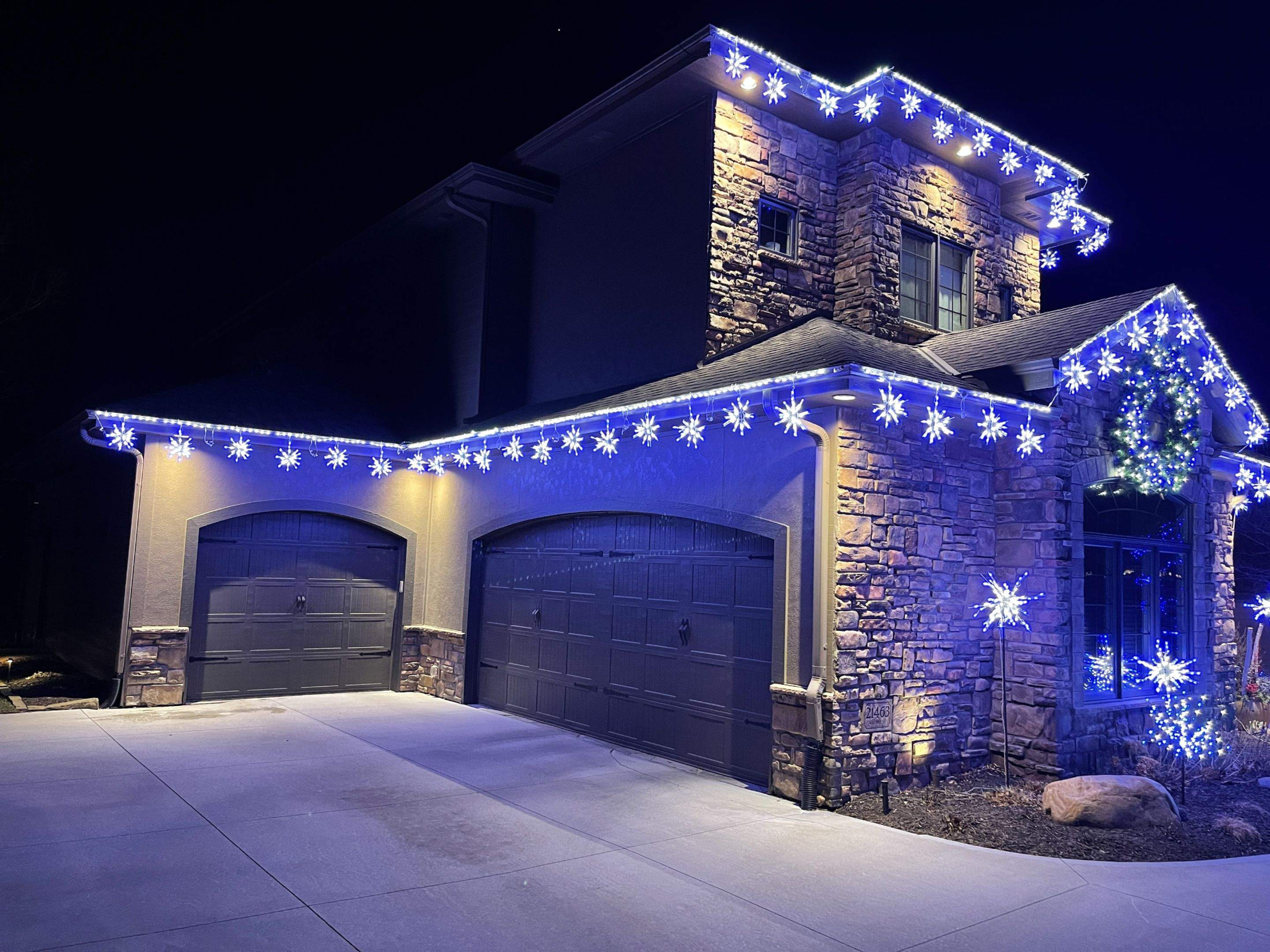
Every type of Christmas light is made for a specific role. Some hold their definition from the street, some are meant to be seen at arm’s length, and some exist to cover landscape features with an even layer of light. A refined holiday display begins with matching each type to the part of the property it suits best.
This guide explains the principal categories of Christmas lights, how they are sized and finished, and where each performs best on a residential or commercial property. Each type includes the applications it is best suited for and the architectural styles it complements.
Quick Reference: Light Types by Application
| Light type | Best application | Reads best from |
| C9 | Rooflines, ridges, large evergreens | Street |
| C7 | Smaller rooflines, window and porch trim | Street and driveway |
| C6 | Railings, wreaths, entry details | Driveway and walkway |
| Mini lights | Garland, wreaths, interior trees | Close range |
| 5mm wide-angle | Tree trunks, canopies, shrubs | All distances |
| Globe lights | Patios, pergolas, outdoor living areas | Within the space |
| Icicle lights | Straight eaves, covered porches | Street and driveway |
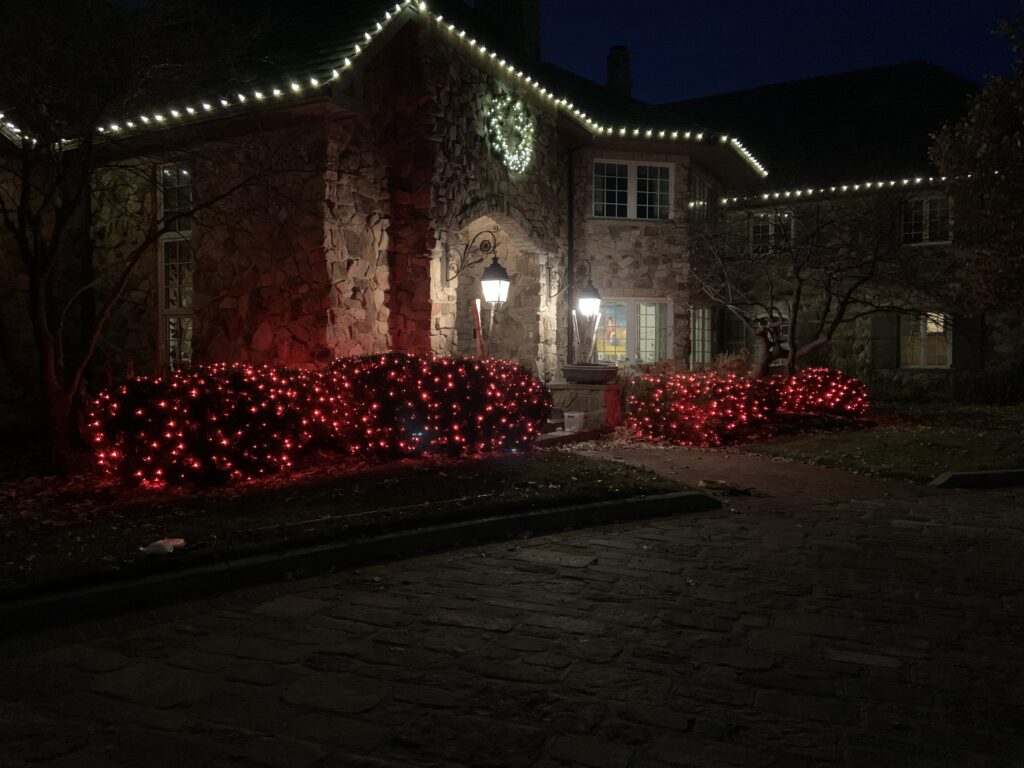
| Net lights | Formal hedges and shrubs | Driveway and walkway |
| Permanent track lighting | Year-round roofline lighting | Street |
How Bulb Sizes Are Named
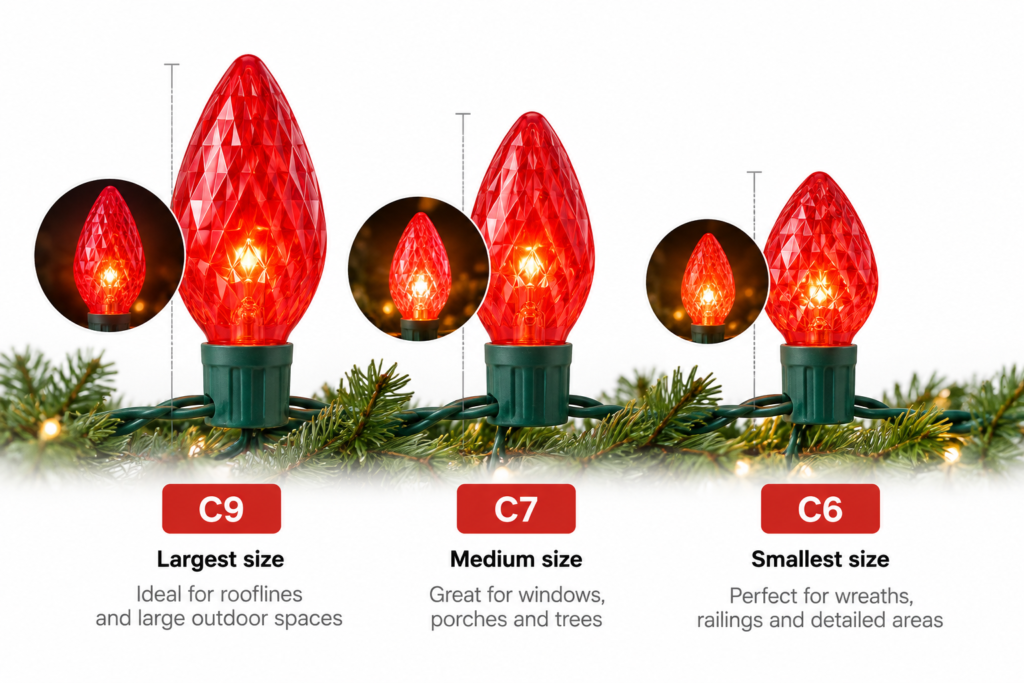
The C in C6, C7, and C9 refers to the cone shape of the bulb, and the number indicates its widest diameter in eighths of an inch. A C6 measures about 3/4 inch across, a C7 about 7/8 inch, and a C9 about 1 1/8 inches. The bases differ as well: C7 bulbs use a small candelabra base, and C9 bulbs use a larger intermediate base, so the two cannot be interchanged within the same string. Understanding these designations makes it easier to specify bulbs in proportion to the architecture they will outline.
Traditional C-Bulb Lights
C9 Lights
C9 bulbs are the established standard for rooflines on larger homes. Their size produces a clear, continuous outline that holds its definition from the street and across the property, which is why they remain the most common choice for professionally installed rooflines. On a large facade, smaller bulbs can lose their presence at a distance, while C9 bulbs give the architecture a confident, legible frame.
Best for: Two-story rooflines, roof ridges and gables, large evergreen trees.
Style match: Traditional, colonial, and estate-scale homes, where a bold, classic outline suits the size of the architecture.
C7 Lights
C7 bulbs carry the same classic shape at a smaller scale. On single-story homes and detailed trim, they keep the lighting in proportion with the architecture, where C9 bulbs could appear oversized. They also suit secondary lines on larger homes, such as window frames and porch rooflines, while C9 bulbs define the primary roofline.
Best for: Single-story rooflines, window trim, porch outlines.
Style match: Ranch, craftsman, and cottage homes, where a traditional appearance needs to stay in proportion with lower rooflines.
C6 Lights
C6 bulbs are the most compact of the C-series and are intended for details seen from a shorter distance. Around the entry, they add definition to features that larger bulbs would overwhelm.
Best for: Porch railings, columns, wreaths, accent features near the front door.
Style match: Farmhouse and traditional homes with porch detailing, where lighting is meant to be appreciated up close.
Mini and Wide-Angle Lights
Mini Lights
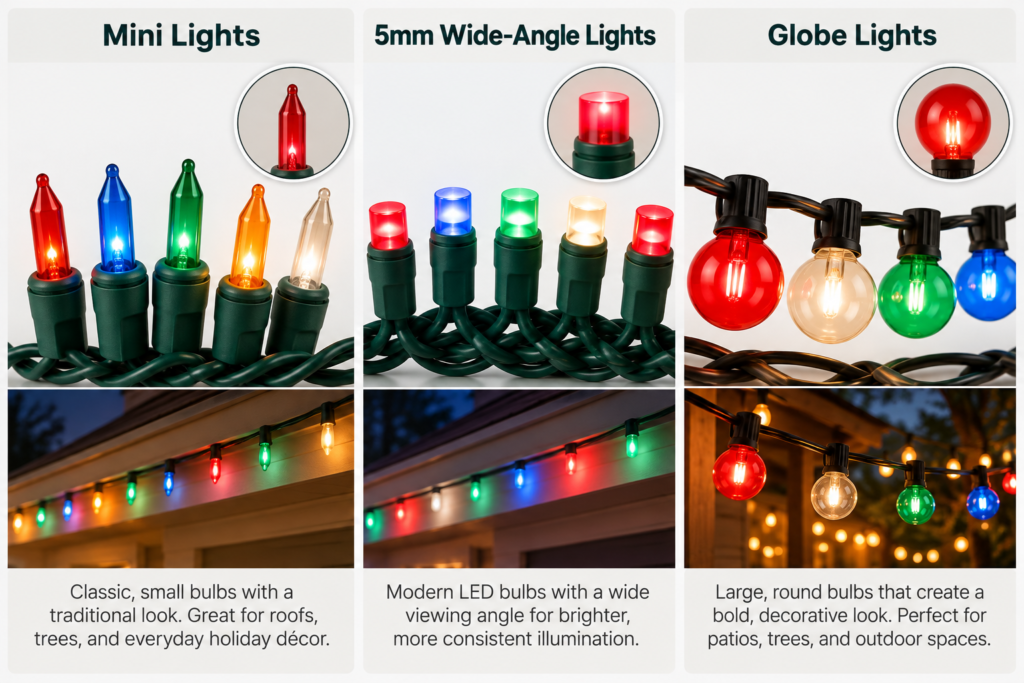
Mini lights are small, closely spaced bulbs designed for detailed greenery. Their fine scale creates a dense, delicate glow at close range. On an exterior roofline, however, they tend to disappear from the street, so they are best reserved for features viewed from the walkway or indoors.
Best for: Garland, wreaths, interior trees, mantels and staircases.
Style match: Layered, classic interiors and entry décor, where a soft, dense glow complements natural greenery.
5mm Wide-Angle Lights
Wide-angle lights use a small concave lens that spreads light broadly despite the bulb’s compact size. Because they do not snag on bark or branches, they are the preferred choice for wrapping tree trunks and canopies, one of the most striking techniques in outdoor holiday design. A row of fully wrapped trees can define an entire property more effectively than any roofline.
Best for: Tree trunk wraps, deciduous tree canopies, shrubs, landscape features.
Style match: Landscape-focused designs on both modern and traditional properties, where mature trees become the centerpiece of the display.
Globe Lights
Globe lights use round bulbs, typically spaced farther apart on a heavier cord. They create a relaxed, hospitable atmosphere and extend naturally beyond the holiday season, which makes them a practical investment for outdoor living spaces.
Best for: Patios, pergolas, decks, outdoor dining and entertaining areas.
Style match: Modern farmhouse, transitional, and contemporary properties with defined outdoor living spaces.
Specialty Lighting Formats
Icicle Lights
Icicle lights hang in short vertical drops along the eaves, adding depth and texture to a roofline. They perform best on clean, straight architecture, where the vertical pattern reads clearly without competing with other details. On complex rooflines with many angles, they can appear uneven.
Best for: Straight eaves, gutters, covered porches and patios.
Style match: Ranch homes and simple gable rooflines with a winter theme. Less suited to ornate or highly detailed facades.
Net Lights
Net lights cover shrubs and hedges with an even grid of light. On formal plantings, they produce a crisp, uniform appearance. Irregular or loosely shaped shrubs, by contrast, often look more natural when wrapped by hand.
Best for: Boxwood hedges, foundation plantings, uniformly shaped shrubs.
Style match: Formal, manicured landscapes, where clean geometric shapes are part of the design.
Permanent Track Lighting
Permanent holiday lighting is installed in a low-profile track beneath the eaves and remains in place throughout the year. Controlled through an app, it can display warm white for the holidays and other colors for different occasions, with no seasonal installation or removal. During the day, the track sits discreetly along the trim.
Best for: Rooflines that will be lit every season, multi-season accent lighting, properties where seasonal ladder work is impractical.
Style match: Contemporary and modern homes, and owners who prefer a clean roofline with no visible strings.
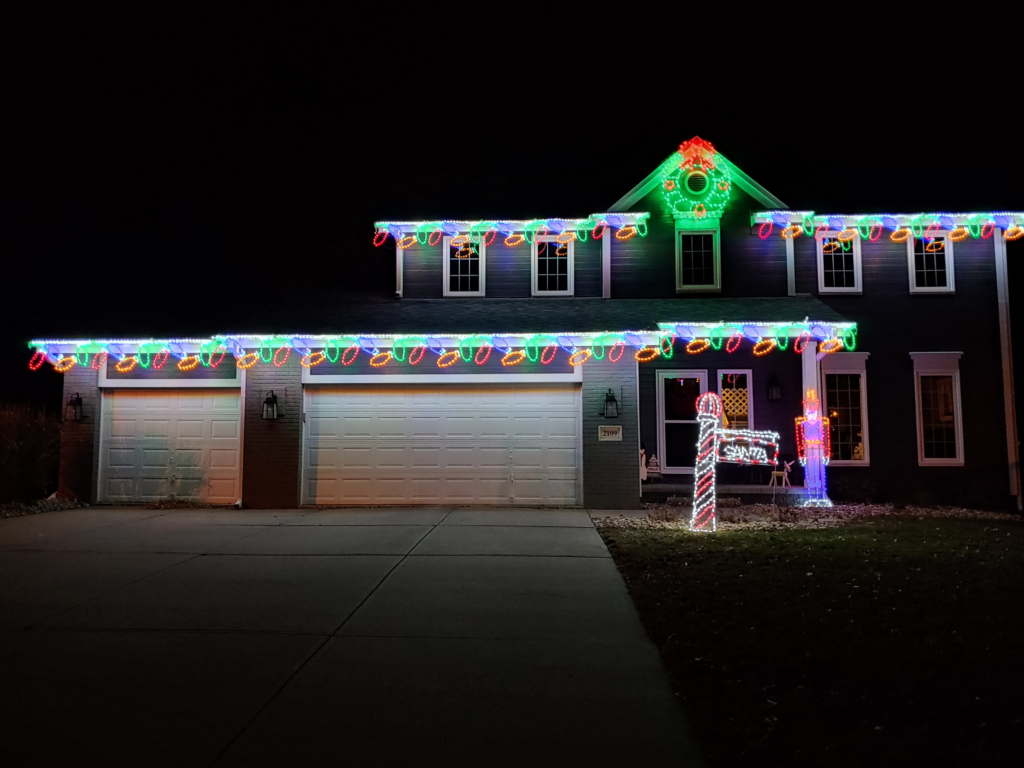
Check out our guide about Permanent Lighting vs. Seasonal Holiday Lighting.
Bulb Finishes
The finish of a bulb shapes the character of its light. Smooth bulbs produce a soft, even glow. Faceted bulbs scatter light for added sparkle and visual texture. Opaque, ceramic-style bulbs offer a vintage appearance with no visible point of light. Selecting one finish and applying it consistently across the property produces a far more refined result than mixing several.
Bulb Spacing
Spacing determines whether a line of lights reads as a continuous outline or a row of separate points. C9 rooflines are commonly installed with bulbs about 12 inches apart, while C7 bulbs are often spaced more closely to suit their smaller scale. Wider spacing creates a more open, traditional rhythm, and tighter spacing produces a bolder, more continuous line. Whatever the choice, consistent spacing across every architectural line is essential.
Commercial-Grade and Retail-Grade Lights
Most lights sold in stores are retail grade, designed for a limited number of seasons. Commercial-grade lights use heavier wire insulation, sealed sockets, and more durable bulbs, built to withstand repeated installation and Midwest winters. Whichever grade you choose, confirm that the lights carry a red holographic UL mark, which indicates they are listed by UL for indoor and outdoor use. For the permanent elements of a display, such as rooflines and large trees, commercial grade is the dependable choice. For more on choosing the light source itself, see our comparison of LED vs. incandescent Christmas lights.
Combining Light Types in One Design
The most accomplished displays use a limited number of light types, each assigned a clear role: one bulb size for the primary roofline, one technique for trees, and one approach for landscape features. Mixing several bulb sizes along the same architectural line, or applying every available type to a single facade, makes a property appear busy rather than designed. Restraint, proportion, and consistency are what give holiday lighting a finished, intentional quality.
Professional Holiday Lighting Design in Omaha
Midwest Lightscaping designs and installs Christmas lighting for homes and commercial properties across the Omaha area. Each design begins with the architecture and landscape of the property, then specifies the light types, bulb sizes, finishes, and spacing that suit it, using commercial-grade products installed with care. Our reputation, reflected in our BBB rating, Google reviews, and Best of Omaha recognition, is built on lighting that looks considered from every vantage point.
To plan a holiday display for your property, schedule a design consultation.