
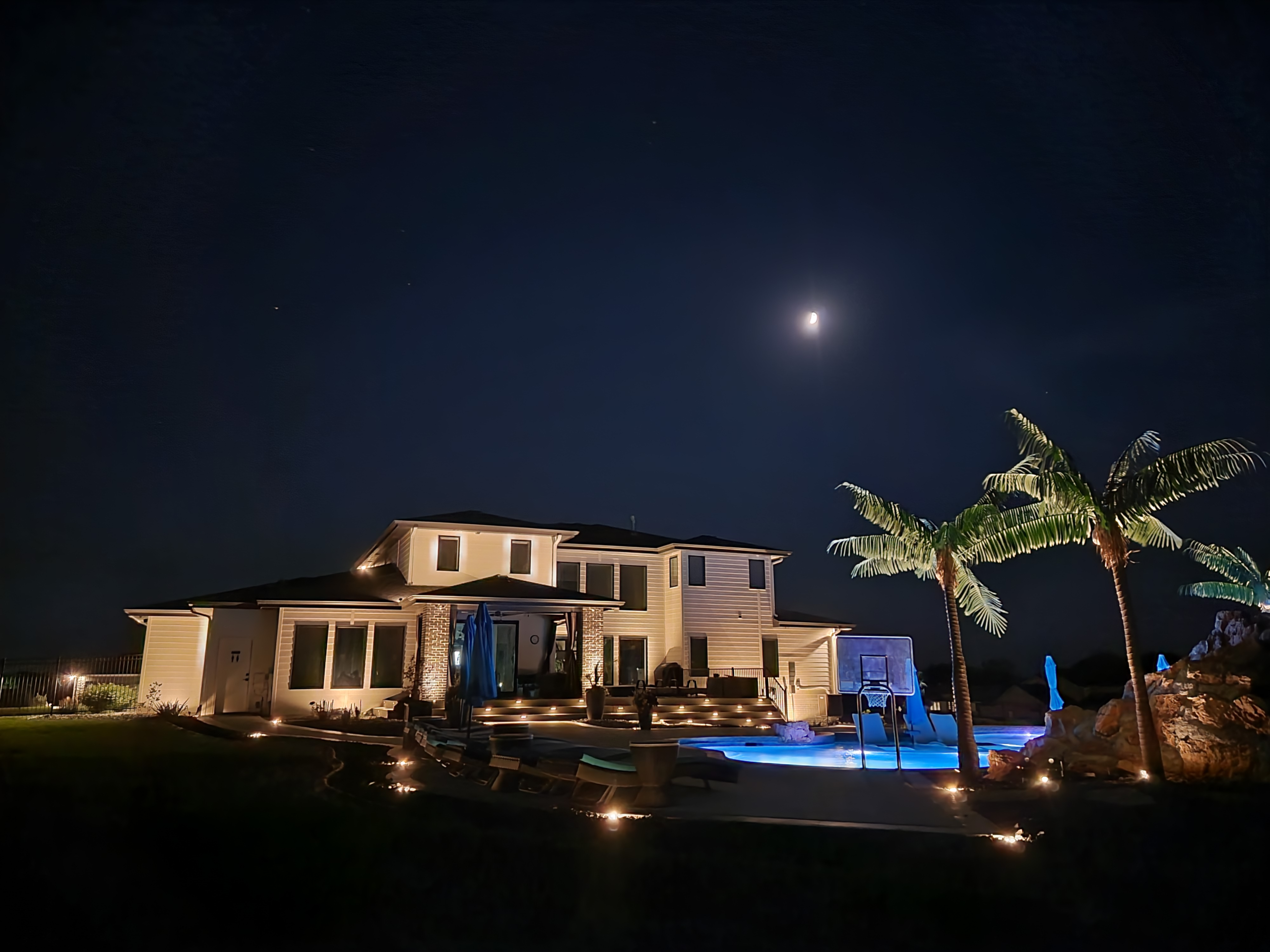
The best pool area lighting ideas are deck lighting that defines the water’s edge, path and step lights, uplit trees and privacy plantings, moonlighting from above, architectural lighting on the walls facing the pool, accents on fire pits and water features, and scenes you control from your phone. Layered together and planned as one design, they make the space safe to move through after dark and give the backyard a finished look from every seat.
In Omaha, that lighting matters for the best part of the summer evening. The sun sets around 9 p.m. in late June, so any swim that runs past 9 ends in the dark. By the end of September, sunset comes closer to 7 p.m.
Midwest Lightscaping has designed and installed outdoor lighting across the Omaha metro since 2011, including pool area lighting in Omaha. We have been voted Best of Omaha every year since 2015 and belong to the Association of Outdoor Lighting Professionals (AOLP) and the International Landscape Lighting Institute (ILLI). The ideas below cover everything around the water: the deck, steps, plantings and structures that frame the pool. The pool’s own underwater lights come from the pool builder, and a good plan is designed to work with them.
Pool Area Lighting Ideas at a Glance
| Idea | Where it goes | What it does | Omaha note |
| Deck and coping lighting | Pool deck, coping, deck borders | Marks the water’s edge so no one misjudges it | Keeps the edge visible on late swims after 9 p.m. |
| Path and step lights | Walk from house to pool, deck steps | Guides wet feet safely to and from the pool | Doubles as walkway lighting once the pool closes |
| Uplit trees and privacy plantings | Trees, evergreens, fences | Frames the pool and adds privacy and depth | Evergreens hold the view through winter |
| Moonlighting over the deck | Trees or pergolas above the pool | Soft overhead light with no glare on the water | Fixtures sit well back from the water and above snow |
| Architectural lighting on facing walls | House walls, pool house, stone features | Gives the pool a lit backdrop instead of a dark wall | Soffit fixtures stay clear of snow and ice |
| Fire pit and water feature accents | Fire pits, waterfalls, outdoor bars | Creates focal points for gathering | Extends backyard use into cool fall evenings |
| App-controlled scenes | Whole pool area | Switches between swim, party, and quiet modes | Adjusts as Omaha’s sunset shifts through the season |
1. Deck Lighting and Edge Definition
Deck lighting uses low, shielded fixtures along deck borders, planters, low walls and steps to wash light across the pool deck, so the edge of the water reads clearly after dark.
Best for: pool decks, raised pool edges and the transition from deck to yard.
Why Deck Lighting Belongs Around a Pool
– A clearly lit deck keeps swimmers and guests from misjudging where the water begins.
– Soft light across the deck shows puddles and pool toys before someone trips.
– Low fixtures trace the shape of the pool from the house without washing out the whole yard.
Deck Lighting Notes for Omaha Pools
Fixtures near the water are where pool area lighting gets technical. The electrical code sets how close each fixture can sit to the water, and fixtures inside that zone must use components rated for pool areas. Lights built into the coping, the capped edge that finishes the pool, are usually part of the pool itself and installed by the pool builder. We coordinate with that work so the deck lighting and the pool’s own lights read as one design. Designers also specify shielded fixtures here, so light lands on the deck rather than in the eyes of swimmers looking back toward the house.
2. Path and Step Lights
Path and step lights are small fixtures set along the walk from the house to the pool and built into deck or patio steps.
Best for: the route from the back door to the pool, deck stairs and changes in level.
Why Path and Step Lights Belong Around a Pool
– Wet, bare feet need a clearly marked route across steps and pavers.
– Lit risers reduce the risk of falls on the way to and from the water.
– A lit route draws guests out to the pool area instead of keeping everyone on the patio.
Path Lighting Notes for Omaha Pools
Most Omaha pools close in the fall and stay covered until late spring, and path and step lights keep earning their place the whole time. The same fixtures light the walk to the patio, the grill, and the garage long after swim season ends. Step lights set into the risers light each tread from the side, so the light stays low and out of the eyes of anyone walking toward the house.
3. Uplit Trees and Privacy Plantings
Uplighting places fixtures at the base of trees, evergreens, fences or ornamental grasses and aims them upward to frame the pool area.
Best for: privacy screens, specimen trees and fence lines around the pool.
Why Uplighting Belongs Around a Pool
– Lit trees and plantings give the pool a finished backdrop instead of a wall of darkness.
– Uplit privacy screens make the space feel enclosed and private after sunset.
– Reflections of lit trees on the water add depth without placing a fixture near the pool.
Uplighting Notes for Omaha Pools
Evergreens such as spruce and pine hold their shape through a Nebraska winter, so uplit evergreens around the pool keep the view from the house worth looking at even with the cover on. Beam spread matters here: a narrow beam suits a tall, slender tree, while a wide canopy needs a broader wash. Our guide to tree lighting ideas that add depth without harsh brightness covers this in more detail.
4. Moonlighting Over the Pool Deck
Moonlighting mounts fixtures high in mature trees or on a pergola and aims them down, so light filters onto the deck the way moonlight does.
Best for: pools with mature trees or a pergola nearby.
Why Moonlighting Belongs Around a Pool
– Overhead light covers the deck evenly with no fixtures at eye level.
– Branch shadows on the deck create a soft, natural pattern.
– Shielded fixtures aimed at the deck, rather than the water, keep bright reflections off the pool’s surface.
Moonlighting Notes for Omaha Pools
Tree-mounted fixtures sit far above winter snow, and a handful of them can light a large deck. Any fixture over the water, or close to its edge, has to meet the electrical code’s height and distance limits. Mounting in a living tree also calls for hardware and methods that allow for years of growth, which is a job for a designer rather than an off-the-shelf kit.
5. Architectural Lighting on the Walls Facing the Pool
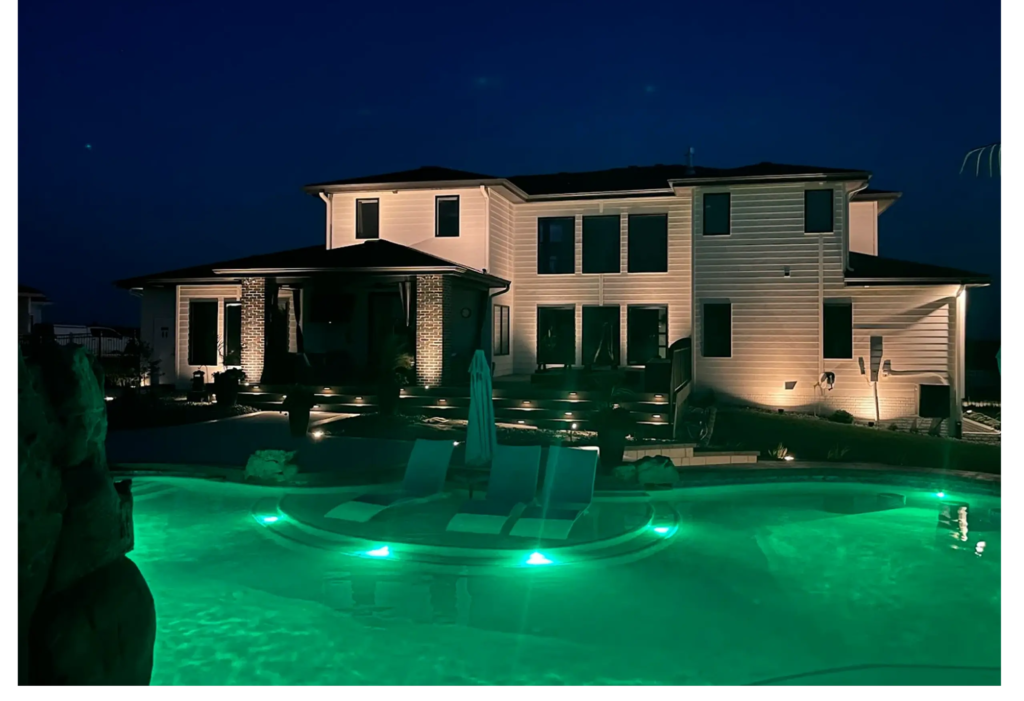
Architectural lighting uses soffit downlights and grazing on the house, pool house or stone features that surround the pool. Grazing places fixtures close to a wall so the light skims across its texture.
Best for: pools framed by the back of the house, a pool house, a cabana or retaining walls.
Why Architectural Lighting Belongs Around a Pool
– A lit facade gives the pool a backdrop instead of a dark wall behind the water.
– Grazing brings out the texture of stone, brick and siding at night.
– Soffit downlights spread usable light across the deck without adding fixtures at ground level.
Architectural Lighting Notes for Omaha Pools
Soffit-mounted fixtures sit under the roof overhang, out of the snow and clear of winter ice, which makes them some of the lowest-maintenance fixtures in the backyard. The back of the house is also what guests see from the water, so it deserves the same design attention as the front.
6. Fire Pit, Water Feature and Outdoor Kitchen Accents
Accent lighting concentrates light on a single feature near the pool, such as a fire pit, waterfall, outdoor kitchen or sculpture.
Best for: fire pits, water features, outdoor kitchens and seating areas beside the pool.
Why Accent Lighting Belongs Around a Pool
– Lit features give guests natural places to gather away from the water’s edge.
– A lit waterfall or water wall becomes a focal point for the whole backyard at night.
– Accents balance the glow of the pool, so the rest of the yard doesn’t fall into shadow.
Accent Lighting Notes for Omaha Pools
A well-lit fire pit area keeps the backyard in use through cool September and October evenings, after the water is too cold for most swimmers. Over an outdoor kitchen, task lighting should be brighter and more even than the accent light around it, so cooking stays practical without flattening the mood of the space.
7. Scenes and App Control
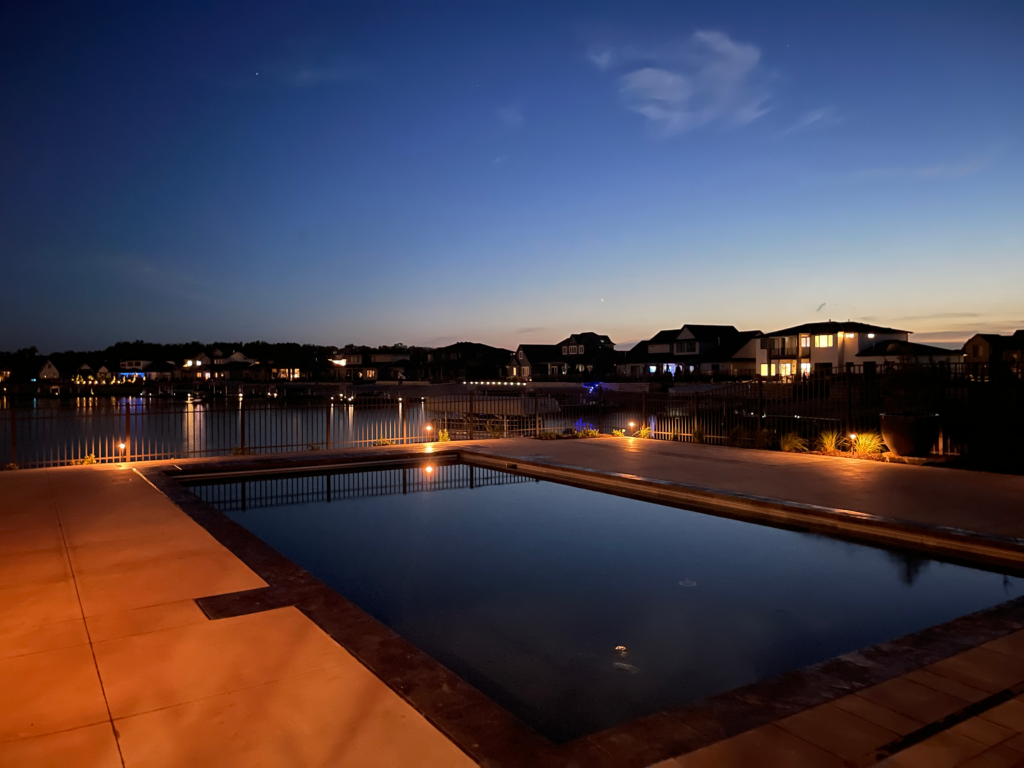
App control ties the pool area lighting into one system run from a phone. Saved scenes cover different nights: bright for entertaining, soft for a late swim, a quiet setting for the view from inside, and color for the holidays.
Best for: pools used for entertaining and households that want a different look on different nights.
Why App Control Belongs Around a Pool
– One tap moves the whole backyard between an entertaining setting and a quiet evening setting.
– Every zone comes up at once from inside the house.
– Schedules run the system on their own, so nothing stays lit all night by accident.
App Control Notes for Omaha Pools
Omaha’s sunset moves nearly two hours between late June and the end of September, from about 9 p.m. to about 7 p.m. A sunset-based schedule follows that change on its own. We set up zones, scenes, and schedules during installation and walk you through them at the final walkthrough.
What a Lighting Designer Looks at First
A pool area plan starts with how the space is used after dark, not with a fixture catalog. Before choosing anything, we look at:
– The route from the house to the water, and every change in level along it
– Where people sit, eat and gather
– The view of the pool from the kitchen, the family room and the primary bedroom
– Focal points worth showing, such as specimen trees, stone walls and water features
– Safe movement and security around the edges of the yard
– The feeling the space should have, lively for parties or calm for a late swim
Visual balance then comes from fixture placement, intensity, color temperature and beam spread. The goal is a pool area that looks complete at night rather than one that is simply brighter. We specify what the space actually needs, even when that means fewer fixtures than expected.
A design plan settles placement, wire routing and control zones in one pass. It also carries into the rest of the property, so the backyard matches the lighting on the front of the house.
What the Electrical Code Requires Near a Pool
The National Electrical Code (NEC) limits how close lighting can sit to a pool, and those limits shape every pool area design.
– Standard low-voltage landscape lighting must be at least 10 feet from the water’s edge, unless NEC Article 680 allows it closer.
– Since the 2014 NEC, listed low-voltage fixtures can sit within 5 feet of the pool’s inside wall, but only when they are powered by a transformer or power supply listed for pool use. A standard landscape lighting transformer does not qualify.
– Fixtures mounted over the pool, or within 5 feet of it horizontally, must be at least 12 feet above the maximum water level.
– Outlets and switches near the pool have their own minimum distances and protection requirements.
These rules are why pool area lighting works best as a planned system installed by a licensed, insured crew, rather than fixtures added one at a time. Your city’s inspector enforces the code edition it has adopted, so the final layout is always checked against local requirements.
Planning Pool Lighting During a New Build or Remodel
Pool area lighting is easiest to get right before the deck is poured. When lighting is planned alongside the pool and hardscape, conduit and sleeves go in under the deck and the control locations are chosen with the house. Fixtures then go where the design needs them, rather than where wire can still reach.
We work with custom home builders, pool builders, architects, and landscape designers from the planning stage. We can join a project as a referral partner or as a vendor inside your team through our outdoor lighting partner program.
Choosing Light Color and Aiming Around a Pool
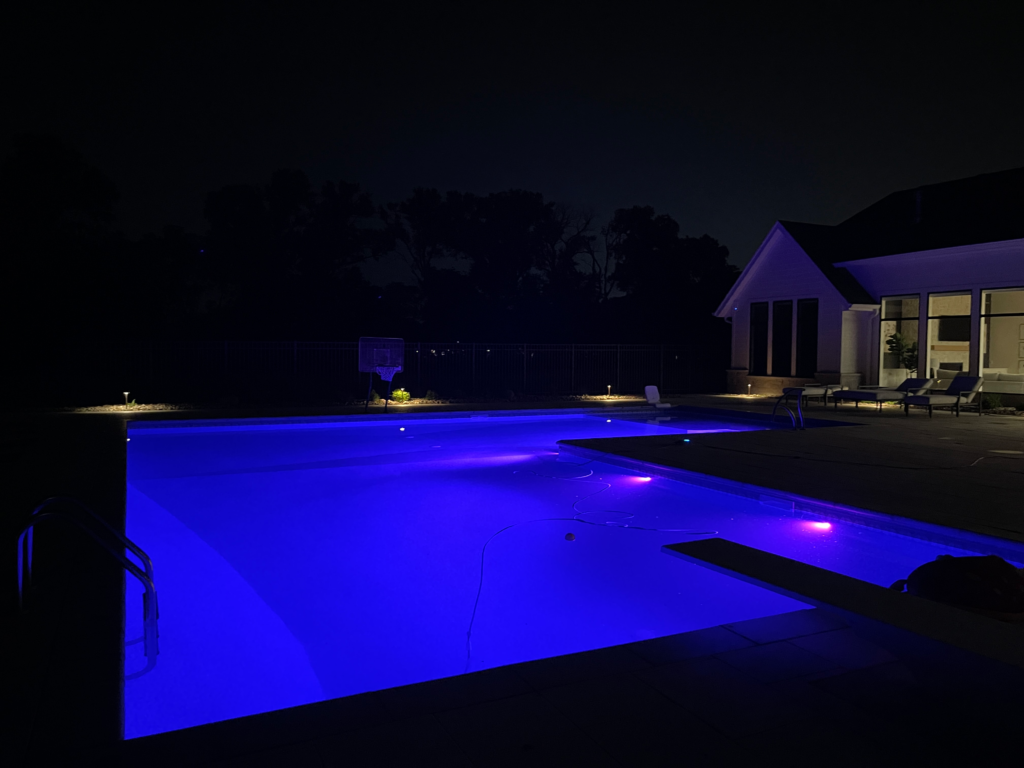
Most pool areas look best in warm white light, roughly 2700K to 3000K. It flatters skin tones, stone and planting, and it reads as relaxed rather than harsh. The pool’s own underwater lights are often cooler or colored, so we choose the white around the pool to sit comfortably beside them instead of competing.
Aiming matters as much as color. Fixtures around a pool stay shielded and aimed at the deck, plantings, and features rather than across the water. Light thrown flat across the surface bounces back as glare and makes it harder to see into the pool.
LED lighting also helps with insects. A 2016 University of Bristol study, published in Ecology and Evolution, found LED lamps attracted about a quarter as many insects as incandescent bulbs. LEDs also drew only a small share of the biting midges that filament bulbs attracted.
Pool Area Lighting Mistakes to Avoid
- Aiming light across the water, which creates glare and hides what is under the surface
- Lining every path with evenly spaced fixtures, which reads like a runway
- Using cool white light above 4000K, which makes a backyard feel like a parking lot
- Leaving the back wall of the house dark, so the pool sits in front of a black backdrop
- Powering fixtures close to the water with a standard landscape transformer
- Adding fixtures one project at a time, with no plan for zones or wiring
Frequently Asked Questions
What are the best pool area lighting ideas?
The best pool area lighting ideas combine deck lighting that defines the water’s edge with path and step lights, uplighting trees or privacy plantings, and accent lighting on features like a fire pit. Layered as one design, they give you safe footing, a clearly defined pool edge, and a backyard that looks finished at night.
Does pool area lighting include the lights inside the pool?
No. Pool area lighting covers everything around the water: the deck, walkways, steps, plantings, walls and nearby features. Lights set into the pool shell or coping belong to the pool itself and come from a pool builder or pool service company. A good pool area design is planned to work with them.
How close can lights be to a pool?
It depends on the fixture and how it is powered. Standard low-voltage landscape lighting must stay at least 10 feet from the water’s edge under the National Electrical Code. Listed low-voltage fixtures powered by a transformer listed for pool use can sit within 5 feet, and fixtures over the pool need at least 12 feet of height above the water.
What color light works best around a pool?
Warm white light between about 2700K and 3000K works best for most pool areas. It complements stone, water, and planting, and it reads softer than cool white light above 4000K, which can make a backyard feel like a parking lot.
Planning Pool Area Lighting for Your Omaha Backyard
The pool area lighting ideas that make the biggest difference are deck lighting that defines the water’s edge, path and step lights, uplit trees and privacy plantings, moonlighting, architectural lighting on facing walls, accents on fire pits and water features, and scenes you control from your phone. Planned together, they cover late swims after 9 p.m. and still give you a lit view from the house once the cover goes on.
Whether we work directly with a homeowner or alongside the builders and designers shaping a larger project, the goal stays the same: make the finished property look better at night than anyone imagined. It starts with a free on-site consultation, followed by a paid design stage that maps every fixture around the pool’s required clearances. When installation is complete, we walk the finished space with you after dark. Seasonal outdoor lighting maintenance then keeps the system aimed and running ahead of each pool season.