
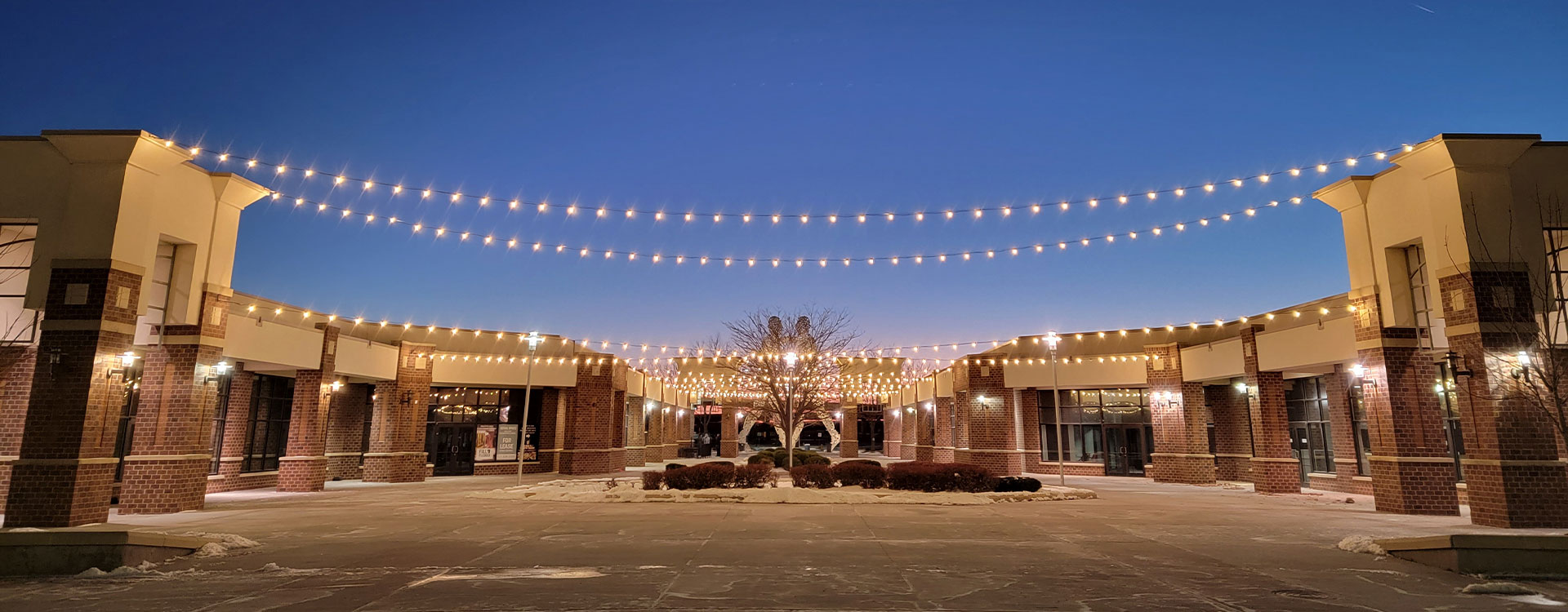
The five types of security lights to have in your yard are motion-activated floodlights, path and step lights, downlights mounted on eaves or trees, backlit house numbers, and app-controlled landscape lighting. Each one covers a different weak spot, and together they leave no dark route to your doors and windows.
Lighting works as a deterrent. In a randomized study of New York City public housing, adding outdoor lighting cut serious nighttime outdoor crime by at least 36 percent. Omaha homeowners have extra reason to plan for it, because the sun sets as early as 4:54 p.m. in December and your yard sits in the dark for hours before bedtime.
Midwest Lightscaping has designed and installed outdoor lighting for Omaha and Lincoln homes since 2011, and the team belongs to the Association of Outdoor Lighting Professionals and the International Landscape Lighting Institute, the standards bodies for this trade. That’s where the fixture types above come from: what we actually specify on security-focused installs, adjusted for Midwest realities like deep eaves, ice load, and long winter darkness, not a generic national list.
Yard Security Lights at a Glance
| Light type | Best spots | Main security benefit | Why it fits Omaha |
| Motion-activated floodlights | Garage, back door, driveway | Startles intruders and wakes up your cameras | Covers long winter nights without running all night |
| Path and step lights | Front walk, steps, driveway edges | Removes the dark approach to your door | Marks walkway edges under snow and ice |
| Downlights on eaves and trees | Side yards, windows, back lawn | Wipes out shadows where someone could hide | Mounted high, so snow can’t bury them |
| Backlit house numbers | Front of house, post by the driveway | Helps police, fire, and EMS find you fast | Stays readable on dark winter evenings |
| App-controlled landscape lighting | Whole yard | Lights everything from your phone, even while away | Adjusts as sunset shifts through the year |
1. Motion-Activated Floodlights
A motion-activated floodlight is a bright LED light mounted on a wall or under an eave that switches on when its sensor detects movement.
Best spots: over the garage, at the back door, and facing the driveway.
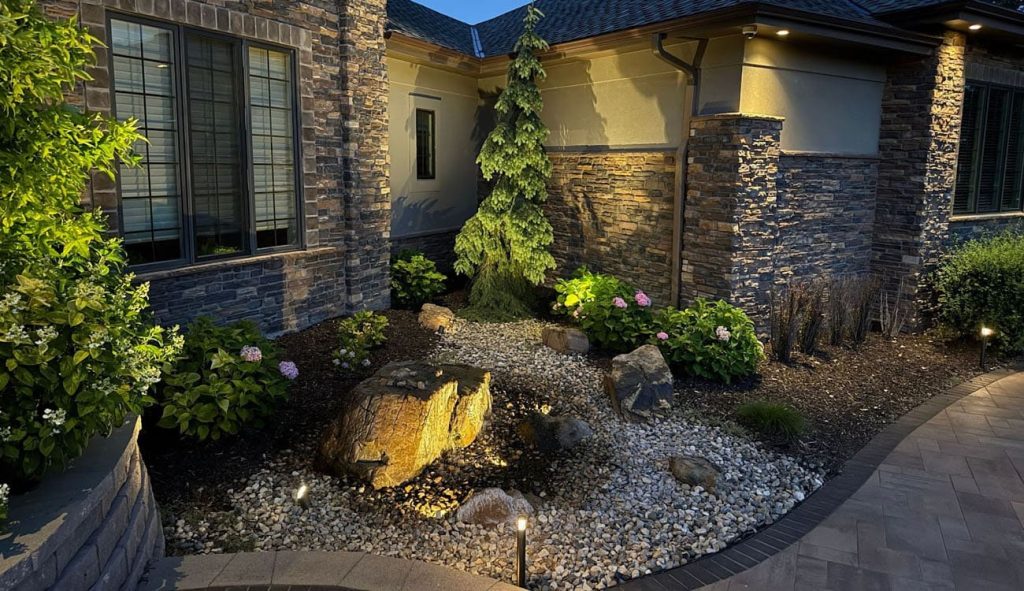
Why Motion Floodlights Deter Intruders
- A sudden burst of light startles anyone who’s somewhere they shouldn’t be.
- The light tells you something is moving outside, even from inside the house.
- Your security cameras get a bright, clear image at the moment it matters most.
- The light only runs when triggered, so it uses far less power than a floodlight left on all night.
Why Motion Floodlights Suit Omaha Homes
Long winter nights leave your garage and back door in the dark for hours, and a motion light covers that time without running up your bill. LED floodlights are built to handle rain and snow in exposed fixtures, so an Omaha winter won’t knock them out.
Placement tip: aim the sensor at your driveway and doors rather than the street, so passing cars and swaying branches don’t set it off all night.
2. Path and Step Lights
Path and step lights are low fixtures along walkways, front steps, and driveway edges that cast light down onto the ground.
Best spots: the front walk, porch and deck steps, and both sides of the driveway.

Why Path Lights Improve Home Security
- A lit walkway removes the dark approach someone could use to reach your door unseen.
- You can see who’s coming up the walk before you open the door.
- Guests and family don’t trip on steps or uneven pavers at night.
Why Path Lights Suit Omaha Homes
December kicks off Omaha’s three snowiest months, and a snow-covered walk hides where the pavement ends and the flower bed begins. Path lights mark those edges for you, your guests, and whoever is shoveling, and step lights make icy stairs easier to see after dark.
3. Downlights on Eaves and Trees
Downlighting means mounting fixtures up high, on your eaves or in mature trees, and aiming them down so light falls across the yard the way moonlight does.
Best spots: side yards, under windows, and open stretches of the back lawn.

Why Downlighting Works for Security
- Even, overhead light wipes out the shadows along the sides of your house where someone could hide.
- It avoids the harsh glare of a single floodlight, which can make the shadows around it look darker.
- Your cameras and neighbors both see a clear, evenly lit yard.
Why Downlighting Suits Omaha Homes
Many Omaha yards have tall shade trees that make good mounting points and spread light across the lawn. Fixtures mounted high also stay above the snow, so a heavy storm won’t bury them the way it can bury ground-level lights.
Roofline tip: if you’re planning permanent outdoor lighting for the holidays, ask about using it for everyday white lighting too, so you get year-round light along the front of the house without climbing a ladder in icy weather.
4. Backlit House Numbers
Backlit house numbers are address numbers with a light behind them, so they glow and stay readable after dark.
Best spots: the front of the house near the door, or a post by the driveway if your house sits far back from the street.
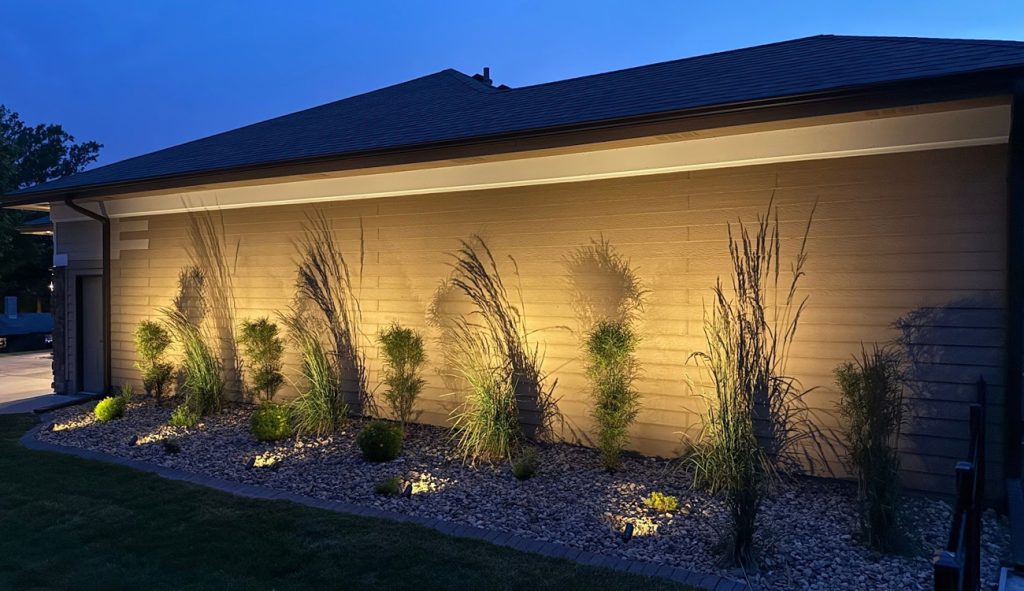
Why Lit House Numbers Matter for Safety
- Police, firefighters, and paramedics find your home faster when they can read the address from the street.
- The International Association of Certified Home Inspectors notes that house numbers are often the only way first responders can identify the right address.
- A lit entry signals that someone is home and paying attention.
Why Backlit Numbers Suit Omaha Homes
With sunset before 5 p.m. for much of the winter, any emergency call on a winter evening happens in the dark. Backlit numbers stay readable when snow, low light, or a dark brick exterior would make standard brass numbers disappear.
5. App-Controlled Landscape Lighting
App-controlled landscape lighting is a low-voltage system that runs on a transformer with a built-in timer and connects to an app on your phone.
Best spots: the whole yard, tying your path lights, downlights, and accent lights into one system.

Why Smart Controls Strengthen Security
- Lights come on automatically every night, so the house never sits dark because someone forgot a switch.
- If you hear something outside, you can light up the entire yard from your phone before you look out the window.
- While you’re traveling, the lights keep running on schedule so the house looks lived in.
Why Smart Controls Suit Omaha Homes
Omaha’s sunset swings from about 9 p.m. in late June to just before 5 p.m. in December, so a basic plug-in timer set in summer leaves your yard dark for hours in winter. A timer that tracks sunset adjusts on its own through the year.
Why Solar Security Lights Struggle in Omaha Winters
Solar security lights are the one common type worth skipping for most Omaha yards. Omaha gets about 9 hours and 12 minutes of daylight on the shortest day of the year, and snow can cover the small panels for days at a time. Solar lights charge the least in exactly the months when you need them to run the longest, so hardwired or low-voltage fixtures give you far more reliable coverage.
How to Aim Security Lights Without Bothering Your Neighbors
Aim every security light down and toward your own yard. A floodlight pointed straight out creates glare that blinds anyone looking toward your house, including your cameras, and it spills light into your neighbors’ windows.
Layering several lower-output lights, such as path lights, downlights, and one motion floodlight, covers more ground with less glare than a single very bright fixture.
Frequently Asked Questions About Yard Security Lights in Omaha
What is the best type of security light for a yard?
The best yard security setup combines motion-activated floodlights at entry points with path lights and downlights that keep the rest of the yard evenly lit. One floodlight alone leaves deep shadows, while layered lighting removes hiding spots around the whole house.
Are motion lights or dusk-to-dawn lights better for security?
Motion lights and dusk-to-dawn lights work best together. Dusk-to-dawn landscape lighting keeps walkways and walls lit all evening, and motion floodlights add a sudden burst of bright light at doors and driveways when someone approaches.
Do outdoor security lights actually reduce crime?
Yes, a randomized study in New York City found that adding outdoor lighting to public housing developments cut serious nighttime outdoor crime by at least 36 percent. Good lighting removes dark hiding spots and makes intruders easier to see and record.
Do security lights work in Omaha’s winter weather?
Wired LED security lights hold up well in Omaha winters because LED fixtures are made to handle rain and snow. Mount motion floodlights and downlights high enough to stay above snow, and skip solar lights, which charge poorly on short, snowy winter days.
Choosing the Types of Security Lights to Have in Your Yard
The five types of security lights to have in your yard in Omaha are motion-activated floodlights, path and step lights, downlights on eaves and trees, backlit house numbers, and app-controlled landscape lighting. Together they cover your entry points, walkways, side yards, and address during the long, dark winter evenings.
Start by walking your yard after dark and noting every spot you can’t see clearly from inside. An outdoor lighting design plan turns that list into fixture locations, and outdoor lighting maintenance each spring keeps sensors aimed and fixtures working after a winter of snow and ice.